

The Best Intermediate Spanish Books: 10 Fun Reads for Adults
In this post: a Spanish coach who learned Spanish as an adult shares the 10 best intermediate Spanish books, from graded readers with audio to authentic short stories in Mexican Spanish. The list starts at low-intermediate (B1) and ramps up the challenge, so you can read your way to fluency. No boring workbooks required.
Let’s see if you can solve this little rompecabezas (puzzle).
You’ve studied Spanish grammar, toured the tenses, and tackled your share of vocabulary lists. But you’re just not making the same progress as when you started.
Even worse? Casual conversations in Spanish still leave you red-faced and tongue-tied.
So, what’s the solution?
Another Spanish course? Not if you already put in the work through a high-quality curriculum.
A Spanish conversation meetup or a language exchange might seem like perfect ways to practice speaking Spanish. But when you’re not ready, that’s a recipe for panic, not fluency.
Crack open a boring workbook? Again? Just no.
What you need is a gentle, enjoyable practice you can do on your own--a little intermediate Spanish reading.
Specifically, stories that pull you in and reinforce what you know. Easy-to-read books that boost your fluency with extensive reading (the kind that is fluent, fun and not full of trips to the dictionary.)
There’s only one caveat. To beat the rompecabezas of the intermediate plateau, you need the right Spanish book. And that’s what this post is all about. (Not sure if you’re quite ready for A2, check out the Spanish books I recommend for total beginners.)
What You’ll Learn
Why extensive reading is the fastest way past the intermediate plateau
The 10 best Spanish books for intermediate learners, ordered from easiest to most challenging
Which books include audio, glossaries, and other supports for reading solo
Three brand-new additions, including short stories in Mexican Spanish and one collection just for adults
How to know when you are ready to move from graded readers to authentic novels

Hola, soy Dominique.
I learned Spanish as an adult: I left my job, moved to Barcelona, and
passed the DELE B2. Later I passed the C1 in Mexico City, where I lived for years. Today I
coach adult Spanish learners, and reading is at the heart of how I teach, from my book
immersion program to these recommendations. Every book below is one I would hand to my
own students.
What’s the perfect book for you in Spanish?
That depends on two things: your level and your situation.
At the B1 level, adults in my book immersion program enjoy authentic Spanish books by Latin American authors—with guided support. Recently, we read Antes de ser libres by Julia Alvarez, and my intermediate students loved how this piece of historical fiction added cultural relevance to their Spanish learning.
But what if you’re reading solo,without a teacher to guide you with vocabulary and spark discussion? Or if you’re not quite ready for a book immersion program?
Read on to find the best Spanish books for intermediate learners. This list of hand-picked books starts with stories designed for independent reading—perfect even at a low-intermediate level.
As you go down the list, each book ramps up the challenge, building your confidence and fluency.

Struggling to move past intermediate Spanish? This free 12-step Spanish learning plan was created by someone who’s been there.
Here are my favorite books in Spanish for intermediate learners:

1. ¿Me voy o me quedo? - Spanish Intermediate (Spanish Edition) by Juan Fernández.
Can an Englishman turn into a Spaniard?
In ¿Me voy o me quedo?, James, a young Englishman, is not just on a mission to learn Spanish; he wants to become Spanish.
He’s traded tea for sangría, mastered flamenco moves on YouTube, and turned siestas into a daily ritual. The locals find him odd.
You’ll read this one with a smile.
With an entertaining plot and accessible language, this book makes learning Spanish fun, helping you build fluency without even realizing it. And you’ll find the author, Juan Fernández, featured in my post on the best YouTube Channels for intermediate Spanish learners.

2. Spanish Novels: Intermediate's Bundle B1 - Five Spanish Short Stories for Intermediates in a Single Book by Paco Ardit.
What would happen to your fluency if you read an entire series of short stories in Spanish?
The Spanish Novels: Intermediate's Bundle B1 by Paco Ardit combines five engaging stories in one Kindle or Audible collection. Want to push the needle on your Spanish in a fun, incremental, and accessible way? This series is for you.
Plunge into essential vocabulary and grammar structures like conditionals, gerunds, pluperfect, and simple past tenses--no more boring workbooks.
Catchy B1 titles like Comedia de locos, Amor online, and Crimen en Barcelona offer humor, suspense, and cultural insights, keeping you hooked
With short chapters, straightforward language, and everyday dialogues, this bundle is designed to let you read, understand, and make gains in your fluency--without getting lost.

3. Misterio en la biblioteca: by María Danader
Modern-day Madrid: a puzzling mystery is unfolding in the city’s library. Follow the intrigue and build your Spanish skills through real-life vocabulary, typical expressions, and useful phrases—all at a reassuring intermediate (B1) level.
You’ll love the way Danader’s books include free audio downloads narrated by native Spanish speakers.
You’ll understand more of what you read if you listen along, and you’ll be training yourself to understand the next time you’re in a Spanish conversation.
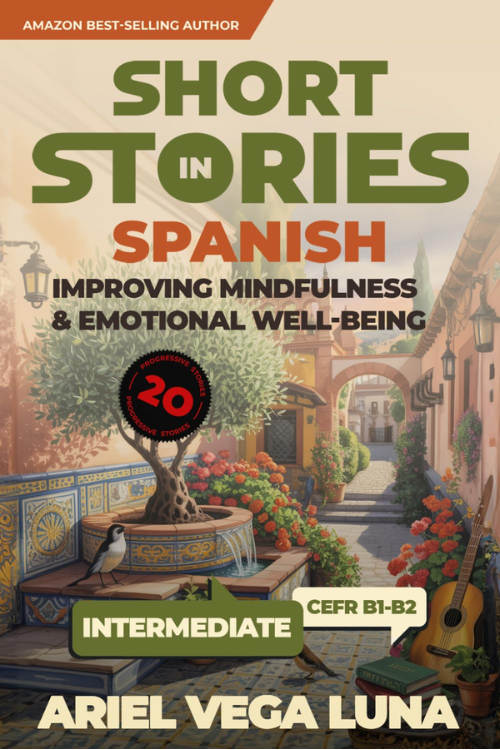
4. Short Stories in Spanish on Mindfulness and Emotional Well-Being by Ariel Vega Luna
Can a Spanish book calm your mind while it builds your vocabulary?
This collection says yes. Vega Luna's short stories center on mindfulness, emotions, and everyday well-being, in accessible Spanish that meets intermediate readers where they are.
And here's what makes it different: you'll pick up the vocabulary of feelings, moods, and inner life, the words most courses skip and real conversations are full of.
If your study sessions tend to feel like a sprint, this book is your slow, satisfying rest.

5. Intermediate Short Stories in Spanish, Olly Richards
As polyglot and creator of StoryLearning, Olly Richards puts it in the introduction to this series:
“One of the main benefits of reading in a foreign language is that you gain exposure to large amounts of words and expressions used naturally. This kind of reading for pleasure in order to learn a language is generally known as ‘extensive reading’.”
Short Stories in Spanish is one of the original and best-known series of language-learning books. The series aims to boost your fluency and speaking skills through reading for fun--without spending all your time with your nose in a dictionary.
Perfect for B1 to B2 learners, this collection of eight engaging stories spans genres like science fiction, crime, history, and thrillers.
Each story matches your level, with controlled language and helps you master the 1,000 most frequent Spanish words. You’ll find authentic dialogues full of conversational expressions to help you pick up spoken Spanish while you read.
Stay engaged without feeling overwhelmed with a glossary, bilingual word list, plot summary, and comprehension questions for each story. A truly immersive and challenging experience.

Master the preterit and imperfect tenses with clear grammar lessons, engaging assignments, and active listening so that you can vividly share your past experiences in Spanish.
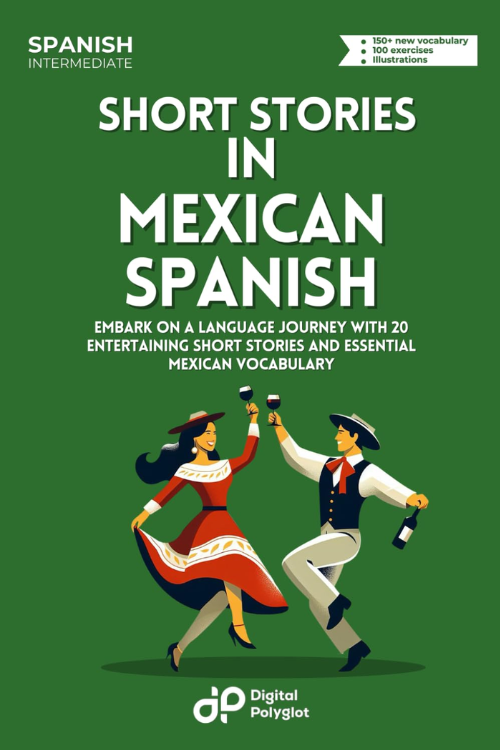
6. Short Stories in Mexican Spanish by Digital Polyglot (46 Book Collection in Latin American Spanish)
Want to read the Spanish people actually speak in Mexico?
Most graded readers teach neutral, textbook Spanish. This one doesn't. Short Stories in Mexican Spanish is written in the living language of Mexico: the expressions, the rhythm, the words you'll hear on the street and around the dinner table.
After years of living in Mexico City, I can tell you that difference matters. Textbook Spanish gets you understood. Mexican Spanish gets you invited back to evenings with new friends.
And the best part? It belongs to Digital Polyglot's 51-book collection in Latin American Spanish, so once you finish Mexico, you can read your way through Colombia, Argentina, Peru, and beyond.

7. Topics that Matter: Spanish Edition (9 books), by Olly Richards
Another way to immerse yourself in Spanish: read up on your interests.
In the Topics that Matter series by Olly Richards you can follow your curiosity into nonfiction in simple Spanish that lets you explore science, culture, and even rock and roll without struggling through native-level material.
You’ll pick up relevant vocabulary on diverse topics that will help you feel more at home on academic, contemporary, and cultural subjects often found at the advanced end of the European Framework. Not sure what that means? Check out this post on evaluating your Spanish level here.
Reviewed by academic editors for accuracy and clarity, this series lets you learn Spanish naturally—while expanding your knowledge about the world.

8. Un café en Buenos Aires: Una aventura con sabor a tango by Estefanía Quevedo Lusby
“Esteban Faraday lleva una vida tranquila en un suburbio de Londres. Un día recibe una carta certificada que le anuncia una misteriosa herencia en Buenos Aires. En este viaje totalmente inesperado conocerá a Zoé, una atractiva bailarina de tango, correrá algunas aventuras de las que puede no salir vivo y descubrirá un secreto acerca de sí mismo que cambiará su vida para siempre...”
If you read that intro in Spanish and felt hooked, you might be ready for a B2-level book to up your challenge. This one leans into the upper-intermediate to advanced range, but once you’ve tackled a few other Spanish readers, you may feel confident giving it a shot.
Beyond an intriguing plot and a mysterious trip to Argentina, this book offers rich resources for a deeper language dive. You’ll find a foreword explaining the unique features of "Rio de la Plata" Spanish, spoken in parts of Argentina and Uruguay.
Each scene includes full-color illustrations, vocabulary and grammar notes, and cultural insights that bring the setting to life.
One of my favorite features of Quevedo Lusby’s books? The Spotify playlist that accompanies the story. There’s nothing like Latin American music to help you connect with the culture.

9. Sobreviví (6-book series) by Lauren Tarshis
High emotion, real-life situations, and compelling non-fiction—all in Spanish. These books cover powerful real-life events through the eyes of relatable young heroes. Though written for a younger audience and not technically graded readers, they’re perfect for adults ready to push themselves.
The Sobreviví series offers an engaging bridge to full novels in Spanish, with stories that motivate, entertain, and expand your understanding of both language, current events, and history.
And let’s be honest—some background vocabulary around events like hurricanes, wars, or earthquakes can make conversations with Spanish-speaking colleagues around the water cooler much easier. That extra cultural context helps you follow the conversation and maybe even join in.
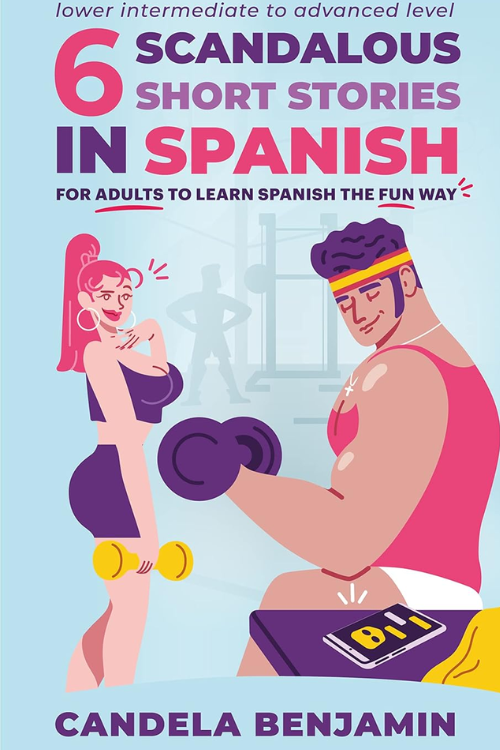
10. 6 Scandalous Short Stories in Spanish
Need a guilty pleasure to keep you turning the pages?
Fair warning: this collection is for adults, and it leans into the fun of it. Six short stories full of gossip, intrigue, and situations your high school Spanish teacher definitely never covered.
Here's why it works: you remember vocabulary attached to a story you couldn't put down.
When the plot is this juicy, the learning takes care of itself.
Read it on your e-reader, and nobody needs to know.

The LIVE community experience for intermediate Spanish learners to develop reading and writing skills through the deep dive of a contemporary Spanish book.
Beyond leveled readers? Your next book en español.
“I’ve reached an intermediate level of Spanish and things are getting hard, really hard. I’m not making the same progress I was seeing when I first started learning Spanish, and my workbooks are just, well, really boring. How do I find that joy of learning Spanish again?”
Here you are, at intermediate. It’s a hard-won battle to get this far as an adult. Yes, everyone who gets this far will meet with some frustration.
But pat yourself on the back. Your hard work has opened a door to a world full of exciting books.
What now?
This is the part where you read yourself into fluency. Read your way to a richer and more varied vocabulary.
And before you know it?
You’ll feel ready to read your first chapter book in Spanish.
Once you do, I think you’ll move on to discover a world of Latin American literature, from novels by contemporary Mexican authors to Southern American classics to Spanish authors, past and present.
From one book lover to another, there is nothing quite like a great book. I hope you find one that makes you feel like you are part of the Spanish-speaking world and pushes you closer to fluency in Spanish. And most of all, I hope you find a story you can’t wait to discuss with other readers.
And between chapters? Keep your ears busy with the best YouTube channels to learn Spanish, whatever your level.
FAQ: Intermediate Spanish Books
What are the best Spanish books for intermediate learners?
Take it from me: graded readers and short story collections written for B1 to B2 learners. Start with ¿Me voy o me quedo?, Paco Ardit's Spanish Novels bundle, or Olly Richards' Short Stories in Spanish, then work your way up to authentic reads like Un café en Buenos Aires.
What level do I need to read books in Spanish?
You can start with graded readers at A2, and reading gets genuinely fun from B1. The books on this list begin at low-intermediate and ramp up to B2. Not sure where you stand? Evaluate your Spanish level first, then pick the book that matches it.
What is the difference between B1 and B2 Spanish books?
B1 books use controlled vocabulary, short chapters, and everyday dialogue, so you can read without a dictionary. B2 books add richer description, regional expressions, and longer scenes, like Un café en Buenos Aires. If you finish a B1 book comfortably, you are ready to try B2.
Are short stories or novels better for intermediate Spanish?
That depends on you. Short stories give you quick wins and variety, which keeps motivation high. Novels build stamina and deeper vocabulary. My advice? Start with short story collections, then graduate to a full novel when one story is no longer enough.
Do I need a textbook or workbook at the intermediate level?
No. If you already worked through a quality curriculum, another workbook will not help you break through the intermediate plateau. What moves the needle now is input you enjoy: reading and listening to real Spanish. Keep a textbook nearby for grammar questions, and spend your study time inside a story.
Can I read intermediate Spanish books online or as PDFs?
¡Claro! Most books on this list come in Kindle editions you can read on any device, and several include audio. Skip the PDF hunt and buy the legitimate digital edition: you support the authors, and you get the audio, glossaries, and notes that make these books shine.
How does reading help you become fluent in Spanish?
Reading gives you massive exposure to natural Spanish: vocabulary, grammar, and expressions in context. Researchers call this extensive reading, and it is one of the most proven paths past the intermediate plateau. You absorb the language while enjoying a story. No flashcards required.
Are these Spanish books good for adults learning Spanish?
Every book here was chosen with adult learners in mind. Most are graded readers written for adults, and even Sobreviví, written for younger readers, works beautifully for grown-ups. One pick, 6 Scandalous Short Stories, is strictly for adults. Choose the story that pulls you in.
Takeaways
From one adult Spanish learner to another, I hope this blog post made you want to crack open a book in Spanish. Here is everything you need to remember while you’re browsing the titles in this post:
The intermediate plateau is normal, and extensive reading is the proven way through it.
Start with graded readers like ¿Me voy o me quedo? and Paco Ardit's B1 bundle, then ramp up to B2 reads like Un café en Buenos Aires.
Short story collections give you quick wins; the new Mexican Spanish and mindfulness collections add variety (and one pick is strictly for adults).
Skip the workbooks. Choose a story you genuinely enjoy: fun is the engine of fluency.
Reading solo is powerful. Reading with guidance and a community takes you even further.
Ready to pick your book? If you want a plan to go with it, grab my free Intermediate Spanish Guide. And if you would rather read with support, vocabulary help, and real discussion, join the waitlist for ELEVATE, my book immersion program for intermediate learners.
What happens next is your call.
Last updated July 2026

Let’s talk about American celebrities that Speak Spanish, for real. Meet the celebrities who can speak Spanish fluently (plus some who are still learning).